

Reconstructive Urology & Urethral Stricture Care | Aligarh

Urethral Stricture: Symptoms, Diagnosis & Treatment Options

Urethral stricture is a narrowing of the urethra caused by scar tissue. It can slow or obstruct urine flow and may recur after previous procedures. Dr. Parwez Alam provides diagnosis-led care for simple and complex strictures, with treatment selected according to the location, length, cause, previous treatment and individual patient needs.

Detailed assessment of stricture location and length

Endoscopic and reconstructive treatment pathways

Recurrent-stricture and urethroplasty evaluation

In-person and online report-review options
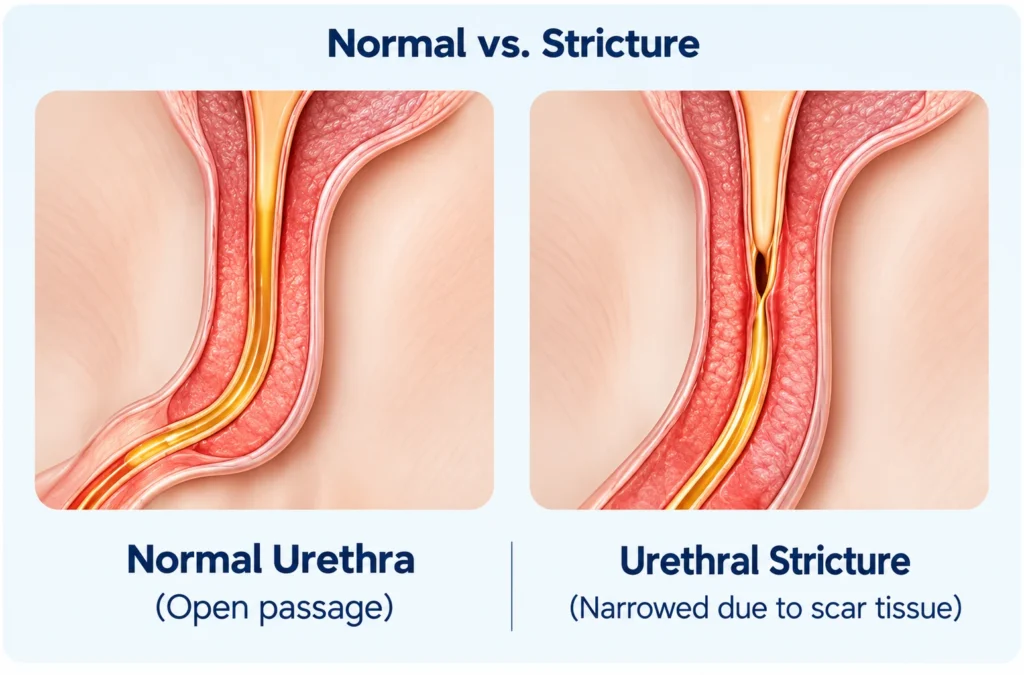

What Is a Urethral Stricture?

The urethra is the tube that carries urine from the bladder to the outside of the body. A urethral stricture develops when scar tissue and fibrosis narrow part of this passage. The narrowing may reduce urinary flow, make the bladder work harder and, in some patients, lead to urinary retention, infection or repeated procedures. In men, strictures may occur in different parts of the anterior or posterior urethra. The exact location, measured length, degree of narrowing, underlying cause and amount of surrounding scar tissue help determine which treatment options are reasonable.
--- Symptoms & Warning Signs ---

Common Symptoms of Urethral Stricture

✓ Weak or slow urinary stream
✓ Difficulty starting urination or needing to strain
✓ Spraying, splitting or dribbling of the urine stream
✓ Feeling of incomplete bladder emptying
✓ Frequent urination or waking at night to pass urine
✓ Recurrent urinary infections, burning or episodes of urinary retention

--- Causes & Risk Factors---

Why Urethral Strictures Develop

✓ Previous urethral instrumentation, catheterisation or endoscopic  procedures
✓ Perineal / straddle trauma or pelvic-fracture urethral injury
✓ Inflammation or previous infection affecting the urethra
✓ Lichen sclerosus and other inflammatory scarring conditions
✓ Previous pelvic or prostate treatment, including selected surgery or radiation
✓ Previous hypospadias repair or other urethral surgery; in some patients no clear cause is identified

--- Diagnosis & Evaluation---

How Urethral Stricture Is Evaluated

Clinical history and focused examination – symptoms, prior procedures, trauma, catheterisation, infections and previous operative records are reviewed.

Urinalysis and urine culture when infection is suspected – infection should be identified and managed before elective intervention when appropriate.

Uroflowmetry with post-void residual measurement – helps assess the urinary flow pattern and whether significant urine remains after voiding.

Urethrography – retrograde urethrogram (RUG), sometimes combined with VCUG, may be used to define the site, length and severity of the narrowing.

Cystoscopy / urethroscopy when clinically appropriate – allows direct visual assessment and may clarify anatomy when combined with imaging.

--- Does Every Urethral Stricture Need a Procedure? ---

Treatment Depends on Symptoms, Anatomy and Previous Care

Some incidentally detected or minimally symptomatic strictures may be observed with follow-up when clinically appropriate. Symptomatic obstruction, recurrent infection, progressive difficulty emptying the bladder, repeated retention or the need for urethral access may make intervention more appropriate.

✓ Severity of urinary symptoms and impact on daily life
✓ Stricture length, location and degree of narrowing
✓ First-time versus recurrent disease
✓ Prior dilation, DVIU, balloon treatment or urethroplasty
✓ Bladder emptying, post-void residual and infection status
✓ Patient goals, general health and reconstructive considerations

---Urethral Stricture Treatment Options ---

From Endoscopic Treatment to Reconstructive Surgery

Observation / Follow-up

For selected patients with limited symptoms or incidentally detected narrowing, depending on clinical assessment.

Urethral Dilation

Gradual widening of the narrowed segment. It can be appropriate for selected strictures but recurrence may occur.

DVIU / Internal Urethrotomy

An endoscopic incision of scar tissue performed under direct vision. Best suited to selected patterns rather than repeated use for every recurrence.

Urethroplasty

Reconstructive surgery that removes or reconstructs the narrowed segment. Technique depends on location, length, cause and prior treatment.

Alternative / Staged Reconstruction

Selected complex, lichen-sclerosus-related, post-traumatic or multiply operated strictures may require grafts, staged reconstruction, perineal urethrostomy or another specialised pathway.

Drug-Assisted Balloon Treatment

Drug-coated or drug-assisted balloon approaches may be considered in selected recurrent / short strictures depending on anatomy, evidence, availability and local regulatory context. Prezilume Therapy has a dedicated page for selected short strictures.

Comparing Common Treatment Pathways

AUA guidance advises offering urethroplasty rather than repeated endoscopic management for recurrent anterior urethral strictures after failed dilation or DVIU, and supports selected use of drug-coated balloon treatment for recurrent bulbar strictures under its specified criteria. Individual practice must also consider local availability, regulation and patient factors.

OptionTypical RoleImportant Limitations / Considerations
Dilation Selected short / uncomplicated narrowing or situations where endoscopic management is reasonable. Recurrence can occur; repeated procedures may not be the best long-term pathway for recurrent anterior strictures.
DVIU Selected endoscopic treatment, particularly for suitable short bulbar strictures. Outcomes depend on anatomy; repeated DVIU for recurrent disease may delay definitive reconstruction.
Drug-Assisted Balloon Selected strictures where a drug-assisted balloon approach is clinically appropriate. Evidence and indication vary by technique / device. Do not treat different drug-balloon approaches as interchangeable.
Urethroplasty Definitive reconstructive option for many recurrent, long, penile or complex strictures. Requires reconstructive planning, anaesthesia and procedure-specific recovery; technique varies by anatomy.
--- Recurrent & Complex Strictures ---

When Reconstructive Urology Becomes Important

A recurrent stricture after previous dilation or DVIU should be reassessed rather than automatically repeating the same procedure indefinitely. Longer bulbar strictures, penile strictures, obliterative segments, lichen-sclerosus-related disease, pelvic-fracture injuries and previously reconstructed urethras often require a reconstructive plan tailored to the anatomy.

✓ Excision and primary anastomosis for selected short strictures when appropriate
✓ Substitution urethroplasty using oral / buccal mucosa grafts in suitable cases
✓ Staged reconstruction for selected complex or scarred tissues
✓ Perineal urethrostomy or other individualised options for selected complex cases

--- Before & After Treatment ---

Planning, Recovery & Follow-Up Vary by Procedure

Before treatment, the urology team may review urine tests, infection status, previous imaging, prior operative notes, medicines that affect bleeding, anaesthetic fitness and the need for additional investigations. After treatment, catheter duration, activity restrictions, pain management, wound care and follow-up testing depend on the procedure performed. Patients should follow the written discharge plan given by the treating team rather than a generic online timeline.
--- Urethral Stricture in Special Situations ---

Some Strictures Need a More Individualised Reconstructive Plan

✓ Lichen sclerosus – inflammatory scarring can affect treatment choice and tissue selection.
✓ Pelvic-fracture or traumatic strictures – the anatomy and gap must be defined before reconstruction.
✓ Radiation-associated strictures – healing, continence and tissue quality require careful counselling.
✓ Post-hypospadias or previously reconstructed urethras – prior surgery may make reconstruction more complex.
✓ Recurrent strictures after multiple endoscopic procedures – re-staging the disease may be more useful than repeatedly treating the same narrowing.
✓ Female urethral stricture – uncommon and evaluated differently; management follows a separate female-urology pathway.

--- Urethral Stricture Care with Dr. Parwez Alam ---

A Structured Approach to Stricture Evaluation and Treatment

Dr. Parwez Alam’s clinical focus includes urethral stricture disease and reconstructive urology. The care pathway should emphasise accurate characterisation of the stricture, explanation of available options and selection of the least burdensome treatment that remains appropriate for the individual anatomy and clinical history.

✓ Consultation & history review
✓ Diagnostic confirmation and stricture mapping
✓ Discussion of endoscopic, balloon-assisted and reconstructive options
✓ Individual treatment plan and procedure-specific counselling
✓ Follow-up for urinary symptoms, flow and recurrence monitoring

--- Online, Outstation & International Consultation---

Have Previous Stricture Reports? Start with a Structured Review

Selected outstation and international patients can arrange an online consultation to review existing reports and understand what additional evaluation may be needed before travelling. A remote review cannot replace physical examination or procedure-specific testing when those are required.

Review of previous RUG / VCUG or cystoscopy reports when available

Discussion of prior dilation, DVIU, balloon treatment or urethroplasty records

Pre-visit guidance on which reports and operative notes to carry

Second-opinion discussion for recurrent or complex urethral stricture

Frequently Asked Questions

What is a urethral stricture?
A urethral stricture is a scar-related narrowing of the urethra that can restrict urine flow. The effect depends on its location, length and severity.
Common symptoms include weak or slow stream, straining, spraying or splitting of urine, incomplete emptying, recurrent infection and, in some patients, urinary retention.
Evaluation may include history and examination, urine tests, uroflowmetry with post-void residual measurement, urethrography and cystoscopy. The exact tests depend on the case.
Medicines may treat associated infection or other symptoms, but established scar tissue generally requires observation, endoscopic treatment or reconstruction depending on the clinical situation.
Dilation widens the narrowing, while DVIU uses an endoscopic incision of scar tissue. Both are endoscopic approaches and are most appropriate for selected stricture patterns.
When is urethroplasty considered?
Urethroplasty is often considered for recurrent, long, penile, traumatic, obliterative or otherwise complex strictures, and may be preferred after failed repeated endoscopic treatment.
Yes. Recurrence can occur after different treatments. The risk depends on anatomy, cause, previous procedures and the type of treatment used.
The stricture itself primarily affects urination, but the underlying cause, pelvic injury and some treatments can be relevant to sexual or reproductive health. These concerns should be discussed individually.
Prezilume Therapy is a Dr. Parwez Alam–developed mitomycin-C balloon approach for selected short urethral strictures. It has a dedicated page and should not be presented as suitable for every stricture or as a replacement for reconstruction when urethroplasty is needed.
Yes. Selected patients can share previous reports and operative records for a remote review, but an in-person examination or further testing may still be required.
hacklink hack forum hacklink film izle hacklinkbetsat girişbetsat girişbetbomfireball casinoporno sitelericasibomcasibom girişjojobetjojobet giriş
Scroll to Top